Introduction: The End of the Pure Coder?
For decades, software engineering was defined by one core skill: writing code. The better you were at translating logic into syntax, the more valuable you became. But something fundamental has shifted. AI coding assistants like Claude, GitHub Copilot, and Cursor are now capable of generating production-quality code in seconds. The bottleneck is no longer writing code—it’s knowing what to build and why.
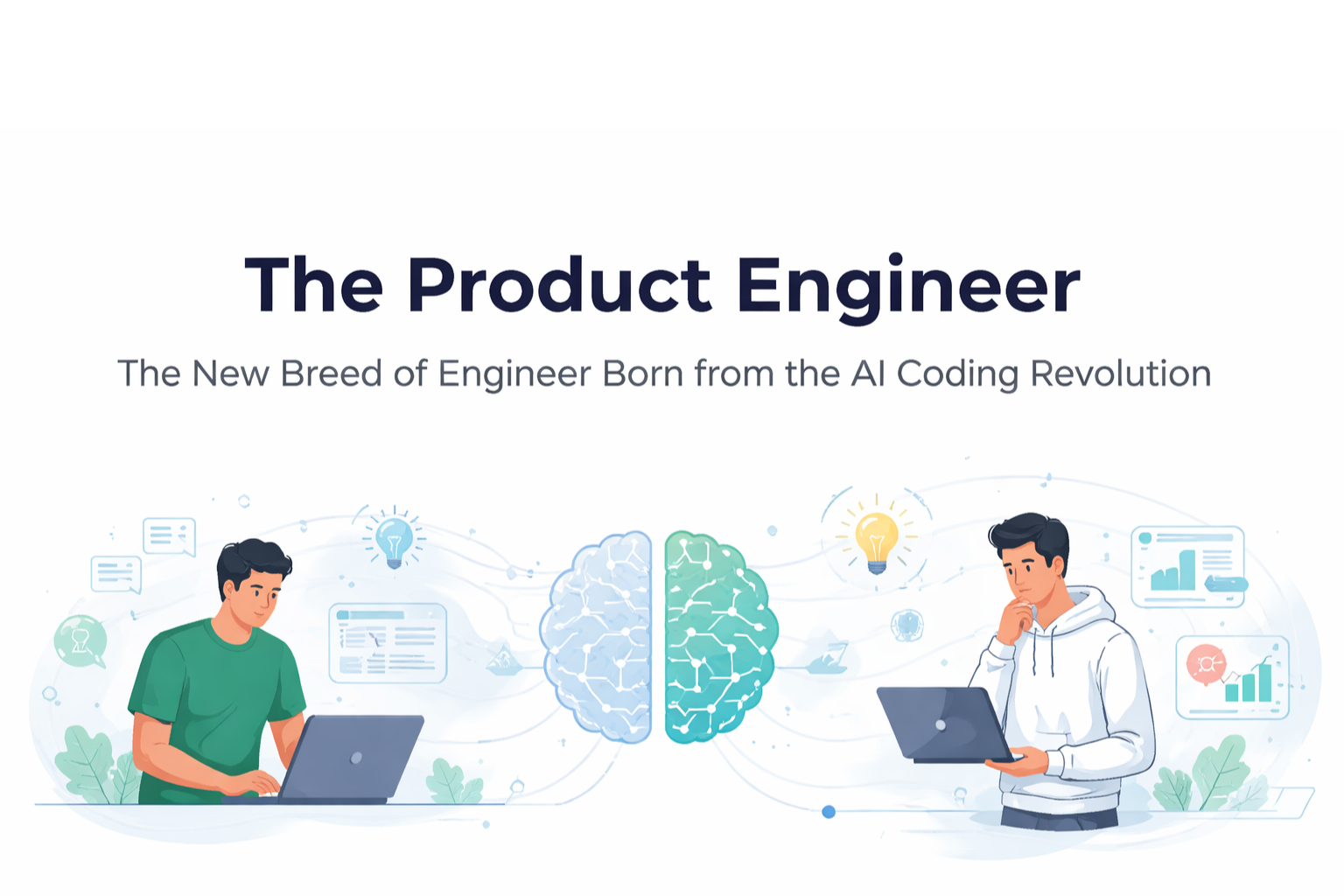
Enter the Product Engineer—a new archetype that blends deep technical ability with product thinking, user empathy, and business strategy. This isn’t just a trendy job title. It’s a structural shift in how software teams operate, and it’s happening right now.
What Exactly Is a Product Engineer?
A Product Engineer is a developer who doesn’t just execute tickets—they shape the product itself. They sit at the intersection of engineering, design, and business. They ask “Why are we building this?” before they ask “How do we build this?”
Core traits of a Product Engineer:
- Ownership mindset: They own outcomes, not just output. Shipping a feature isn’t the goal—shipping impact is.
- User obsession: They talk to users, read support tickets, and watch session recordings. They feel the pain before writing a line of code.
- Business fluency: They understand metrics, funnels, retention, and revenue. They can debate pricing strategy as comfortably as database indexing.
- Rapid prototyping: With AI handling boilerplate, they can go from idea to working prototype in hours, not weeks.
- Cross-functional communication: They bridge the gap between stakeholders, designers, and the engineering team effortlessly.
Why AI Made This Role Inevitable
Before AI coding tools, a huge chunk of engineering time was spent on implementation details—writing CRUD operations, setting up configurations, debugging syntax errors, and wiring up APIs. AI has compressed that work dramatically.
When code generation becomes near-instant, the engineer who only knows how to code loses their competitive edge. The value shifts upstream: to problem discovery, solution design, and prioritization. The Product Engineer thrives here because they were never just coders—they were builders who happened to use code as their medium.
Think of it this way: AI gave every engineer a power tool. But the engineer who also knows architecture, user behavior, and market dynamics becomes the architect—not just the carpenter.
Product Engineer vs. Traditional Roles
vs. Full-Stack Developer
A Full-Stack Developer knows both frontend and backend. A Product Engineer knows both plus why the feature exists, who it’s for, and how to measure if it worked. Full-stack is a technical scope. Product engineering is a mindset.
vs. Product Manager
A Product Manager defines what to build. A Product Engineer can do that AND build it. They reduce handoff friction, move faster, and often catch feasibility issues that a non-technical PM would miss. In small teams, one Product Engineer can replace the PM + Developer duo entirely.
vs. DevOps / Platform Engineer
DevOps focuses on infrastructure reliability. Product Engineers focus on user-facing impact. They’re complementary—but the Product Engineer is the one deciding what gets shipped to users.
What Does a Product Engineer’s Day Look Like?
- Morning: Review user feedback from the last release. Check analytics dashboards. Identify a drop-off in the onboarding funnel.
- Mid-morning: Sketch a solution on paper. Validate the approach with the designer over a quick call.
- Afternoon: Use an AI coding assistant to scaffold the feature. Write the critical business logic manually. Push a PR.
- Late afternoon: Write a brief product note explaining the change, the hypothesis, and the success metric.
- End of day: Ship to staging. Set up an A/B test flag.
Notice: no ticket was assigned. No sprint ceremony was needed. The Product Engineer identified the problem, designed the solution, built it, and set up measurement—all in one day.
The Skills Stack for 2026 and Beyond
If you want to become a Product Engineer, here’s the skill stack that matters most:
- AI-augmented development: Know how to prompt, iterate, and validate AI-generated code. Treat AI as a junior developer you’re mentoring.
- Product analytics: Be fluent in tools like Mixpanel, Amplitude, or PostHog. Know how to define and track meaningful KPIs.
- User research basics: Conduct interviews, build surveys, and synthesize feedback into actionable insights.
- System design with tradeoffs: Understand not just how to build a system, but which corners to cut and which to over-engineer.
- Communication: Write clear product specs, persuasive proposals, and concise Slack messages. Your ideas are only as good as your ability to communicate them.
Is This the End of Specialization?
No. Deep specialists—in security, performance, ML infrastructure, distributed systems—will always be essential. But the generalist-specialist hybrid, the one who can go wide and deep, is becoming the most versatile player on any team. The Product Engineer is that hybrid.
Companies like Vercel, Linear, and Supabase have been building with this model for years. Their teams are small, fast, and incredibly productive—because every engineer thinks like a product owner.
Final Thoughts
AI didn’t kill the software engineer. It killed the engineer who was only a coder. The ones who thrive in 2026 and beyond are those who combine technical depth with product instinct. They don’t wait for specs—they write them. They don’t just close tickets—they move metrics.
The Product Engineer isn’t a new role. It’s the natural evolution of what great engineers have always been. AI just made it impossible to ignore.